









Introduction
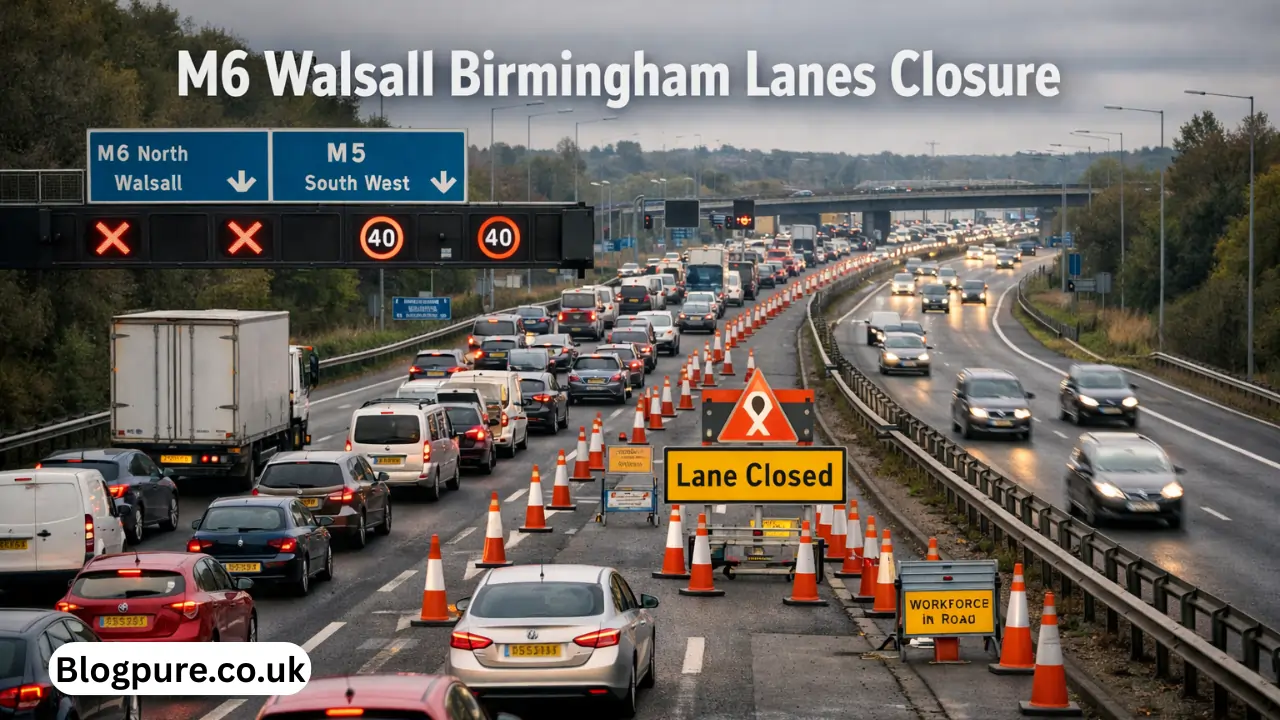
The m6 walsall birmingham lanes closure problem has crossed the point of being an occasional disruption. It now defines the experience of driving through this corridor. Anyone relying on this route is no longer asking whether there will be delays—they are calculating how bad those delays will be.
Why the Walsall–Birmingham stretch struggles under pressure
The section between junctions 7 and 10 carries a dense mix of commuter traffic and freight movement. That combination alone would be manageable if the road had enough flexibility, but it doesn’t. The design dates back to a time when traffic demand was significantly lower.
The m6 walsall birmingham lanes closure pattern reflects this mismatch. Traffic merges aggressively near Great Barr, vehicles switch lanes frequently, and there is almost no margin for error. When flow is interrupted, it doesn’t recover quickly.
The structural bottleneck at key junctions
Junction 7 acts as a central choke point. Traffic entering and exiting here disrupts the rhythm of vehicles already on the motorway. Add even a minor lane restriction and the entire system tightens.
Junctions 9 and 10 face similar pressure. These aren’t isolated trouble spots. They are connected weak points, and when one slows down, the effect spreads across the stretch.
Roadworks are constant because they have to be
The m6 walsall birmingham lanes closure situation is heavily driven by ongoing maintenance. This is not cosmetic work. It involves core infrastructure that can’t be ignored any longer.
Bridge joints across this section have reached a stage where repairs are unavoidable. Road surfaces degrade faster under heavy traffic loads. Drainage systems need upgrades to prevent long-term damage.
Why overnight closures are not enough
Most work is scheduled between 9pm and 6am, but that doesn’t isolate the disruption. Late-night freight traffic still relies on this route. Early commuters often encounter leftover congestion or reduced speeds.
When larger projects require full closures, the impact extends beyond a single night. Traffic patterns shift, and the next day absorbs the pressure.
The m6 walsall birmingham lanes closure cycle becomes continuous rather than occasional.
Accidents escalate delays instantly
Accidents on this stretch are not rare, and their impact is immediate. A single crash can close multiple lanes, and that is enough to stall traffic for miles.
When three lanes are blocked, the remaining capacity collapses. Vehicles slow sharply, queues form, and delays grow quickly. The m6 walsall birmingham lanes closure effect during these incidents becomes far more severe than during planned works.
Why recovery takes longer than expected
Even after an accident is cleared, traffic doesn’t return to normal immediately. Congestion lingers because vehicles are still filtering through the restricted area.
Driver behavior also plays a role. Sudden braking, hesitation, and last-minute lane changes make recovery slower than it should be.
Breakdowns create hidden disruption
Breakdowns rarely get attention, but they are one of the most consistent triggers behind the m6 walsall birmingham lanes closure issue.
A vehicle stopped in lane one forces traffic to shift lanes abruptly. This creates uneven flow and increases the risk of secondary incidents.
It doesn’t take much. One broken-down van during peak hours can produce delays that rival those caused by larger incidents.
Smart motorway systems haven’t removed the pressure
Technology has been introduced to manage traffic more efficiently. Variable speed limits and controlled lanes aim to smooth flow and reduce sudden stops.
The reality is more mixed. The m6 walsall birmingham lanes closure situation still persists despite these upgrades. In some cases, lane closures within a smart motorway setup feel more restrictive because drivers have fewer options to adjust.
The gap between design and real-world conditions
Smart systems rely on consistent driver behavior and balanced traffic flow. This stretch rarely offers either. Heavy usage and unpredictable conditions limit the effectiveness of these systems.
The technology helps manage congestion, but it does not eliminate the root cause.
Real delays are longer than official estimates
Traffic updates often report delays in minutes, but drivers experience them differently. A 30-minute delay can stretch far beyond that when conditions shift.
The m6 walsall birmingham lanes closure impact changes constantly depending on traffic density and timing. Peak hours amplify every issue.
Morning and evening rush periods are especially sensitive. Any disruption during these times spreads quickly and takes longer to clear.
Alternative routes fail under pressure
Avoiding the M6 sounds simple, but it rarely works in practice. Local roads through Birmingham and Walsall are not built to handle diverted motorway traffic.
When drivers leave the motorway due to the m6 walsall birmingham lanes closure situation, surrounding roads become congested almost immediately.
Routes connecting to the M5 or M42 can offer temporary relief, but they are not reliable solutions. Traffic shifts rather than disappears.
Timing determines the severity of disruption
Not all closures carry the same weight. Timing is a critical factor.
Daytime lane closures have the strongest impact. Traffic volume is already high, so any restriction leads to immediate congestion.
Night closures are less visible but still important. They affect freight movement and can create knock-on delays for early commuters.
Weekend full closures are another challenge. They redirect traffic in large volumes, affecting nearby routes and extending delays into the following day.
The m6 walsall birmingham lanes closure pattern changes depending on when it happens, not just where.
Driver behavior makes a measurable difference
The human factor cannot be ignored. Drivers contribute to how congestion develops and how quickly it clears.
Late lane changes near closures slow traffic down. Overreaction to minor disruptions creates unnecessary braking. Hesitation at merge points reduces overall flow.
Even with the same level of disruption, traffic outcomes can differ based on driver response.
The m6 walsall birmingham lanes closure issue is not just about infrastructure. It is also about how people navigate it.
Long-term pressure is the real issue
Maintenance projects and traffic management systems address immediate problems, but they don’t resolve the larger imbalance.
This stretch carries more vehicles than it was designed for. That gap between capacity and demand continues to widen.
The m6 walsall birmingham lanes closure situation reflects that imbalance every day. Fixing surfaces and upgrading systems can only go so far.
Without addressing capacity limits, disruptions will remain a constant feature of this route.
What drivers should realistically expect
There is no short-term fix waiting around the corner. The pattern of closures, delays, and unpredictable congestion will continue.
Drivers using this route need to adjust expectations. Some journeys will be manageable. Others will involve extended delays without clear warning.
The m6 walsall birmingham lanes closure issue is now part of the normal driving experience in this region.
Conclusion
The m6 walsall birmingham lanes closure situation is not a temporary inconvenience. It is a reflection of deeper structural pressure on one of the UK’s busiest motorway corridors. Roadworks, accidents, and breakdowns are only surface-level triggers. The real challenge is a system running at full capacity with no room for error. Until that changes, drivers will continue to face a route where delays are not the exception but the baseline.
FAQs
1. How often do lane closures happen on the M6 between Walsall and Birmingham?
They occur regularly due to ongoing maintenance, incidents, and infrastructure upgrades. It is rare to find this stretch completely clear for long periods.
2. Are night-time closures better for avoiding delays?
They reduce daytime disruption but still affect freight and early commuters. Delays can carry over into the morning.
3. What causes the longest delays on this route?
Multi-lane accidents and overlapping roadworks create the most severe congestion, often leading to extended queues.
4. Can checking traffic updates prevent delays?
It helps, but conditions change quickly. Real-time updates improve planning but cannot guarantee a smooth journey.
5. Is congestion expected to improve in the near future?
Short-term improvements are unlikely. Ongoing works and high traffic demand mean disruptions will continue for the foreseeable future.
Read More: Coerant: Clear Writing That Drives Structure, Flow, and Reader Engagement