









Introduction
The glasgow water main break shettleston road didn’t just interrupt traffic and water supply—it exposed how fragile the city’s core systems have become. Anyone expecting this to be a one-off incident is ignoring a pattern that has been building for years.
What really happened during the incident
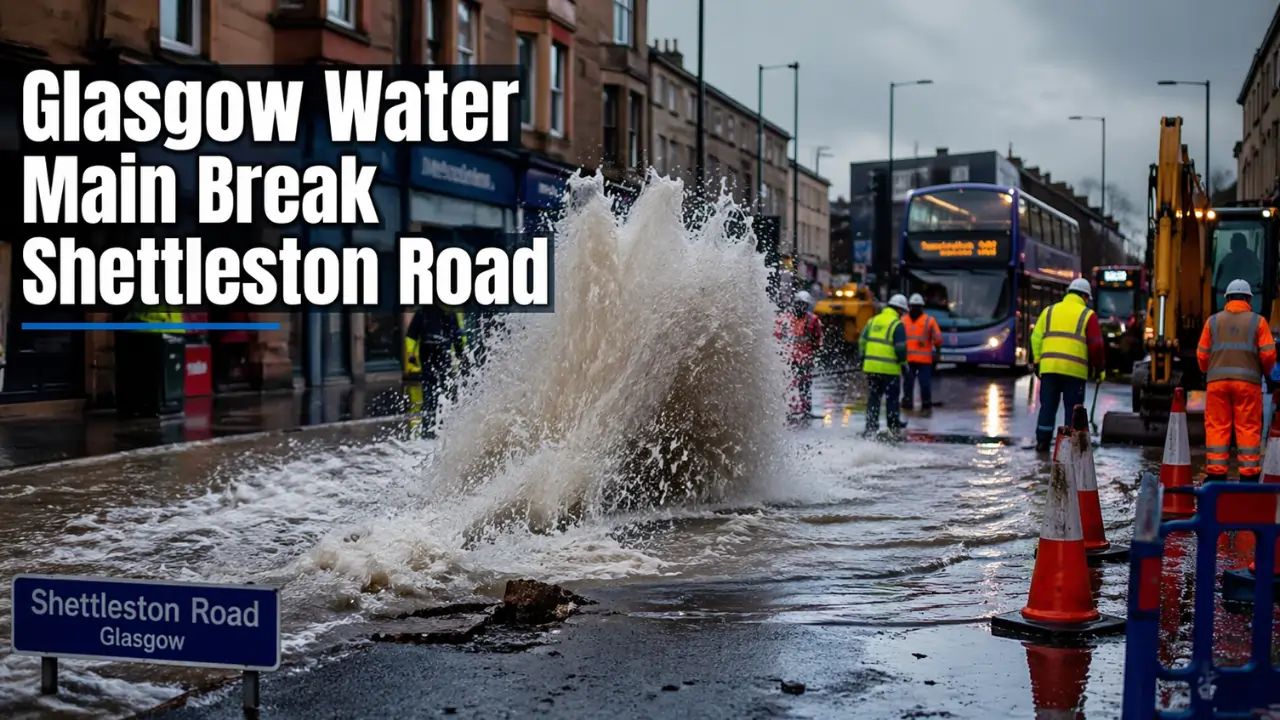
The glasgow water main break shettleston road unfolded fast enough to catch residents and commuters off guard. Water forced its way through the road surface, spreading across lanes and forcing immediate closures. Within a short time, nearby homes began reporting reduced water pressure or complete loss of supply.
This wasn’t a slow leak. The glasgow water main break shettleston road was a full structural failure beneath the surface, the kind that turns a normal street into an emergency zone within minutes.
Transport disruption followed quickly. Buses were diverted, private vehicles rerouted, and congestion spread beyond the immediate area. What started as a pipe failure became a wider movement problem affecting the East End.
Why the glasgow water main break shettleston road was inevitable
There’s a tendency to treat events like the glasgow water main break shettleston road as unexpected. That’s not accurate.
Glasgow’s water infrastructure includes pipes that have been in service for decades. These systems were built for a different era—lower demand, lighter traffic, and less environmental stress. Today, they operate under constant pressure.
Over time, internal corrosion weakens pipe walls. External stress from road traffic and shifting ground adds further strain. When pressure fluctuates within the system, weak points give way.
The glasgow water main break shettleston road fits perfectly into that pattern. It wasn’t surprising. It was overdue.
Immediate consequences people could not ignore
The most obvious impact of the glasgow water main break shettleston road was water disruption. Households in the surrounding area experienced either no water or unreliable flow. In some cases, water appeared brown or cloudy, which happens when sediment is disturbed inside older pipes.
But the impact didn’t stop there.
Local businesses faced an immediate drop in customers due to road closures. Shops relying on steady foot traffic saw empty entrances. Cafes and service providers that depend on running water had no choice but to pause operations.
Traffic disruption amplified everything. The glasgow water main break shettleston road created a ripple effect across nearby routes. Drivers unfamiliar with diversions slowed the flow even further, extending delays into surrounding areas.
This wasn’t just inconvenience. It was economic and practical disruption combined.
How response teams handled the situation
Once the glasgow water main break shettleston road was identified, response crews moved quickly. The damaged section of the pipe was isolated to stop further water loss. Excavation teams began digging to locate the exact failure point.
Repairs were carried out while alternative supply routes were activated where possible. After the fix, the system had to be flushed to remove debris and restore water clarity.
The response was efficient, but it followed a familiar pattern—react, repair, restore.
The glasgow water main break shettleston road highlights a system designed to respond well under pressure, but not necessarily to prevent that pressure from building in the first place.
The hidden cycle of repeated failures
One issue rarely discussed openly is how repairs are handled over time. The glasgow water main break shettleston road likely involved replacing or reinforcing a damaged section, not the entire pipeline.
That approach is practical in the short term. It minimizes disruption and keeps costs manageable.
But it creates a cycle.
An aging pipeline with one repaired section still contains other weak points. Over time, those points fail too. The result is a series of incidents spread across different locations, all tied to the same underlying problem.
The glasgow water main break shettleston road is one event in that cycle, not the end of it.
Why Shettleston is a warning, not an exception
There’s nothing uniquely vulnerable about Shettleston. That’s what makes the glasgow water main break shettleston road more concerning.
Other parts of Glasgow share similar infrastructure conditions—older pipes, heavy traffic, and limited large-scale upgrades. The same pressures exist across multiple districts.
This means the glasgow water main break shettleston road is less about one road and more about a system-wide issue. Treating it as isolated misses the bigger picture.
Similar disruptions have already occurred in different parts of the city. Each one reinforces the same message: the network is aging faster than it’s being replaced.
The cost of delaying real upgrades
Replacing entire sections of water infrastructure is expensive and disruptive. Roads must be dug up. Traffic must be rerouted. Projects take time.
That’s why these upgrades are often delayed.
The glasgow water main break shettleston road shows the cost of that delay. Emergency repairs, business losses, traffic disruption, and public frustration all carry a price. It’s just not paid in one place at one time.
Instead, it’s spread out across incidents.
At some point, the combined cost of repeated failures outweighs the cost of proactive investment. The glasgow water main break shettleston road suggests that point is getting closer.
What needs to change to avoid repeat incidents
Fixing the problem behind the glasgow water main break shettleston road requires a shift in approach.
Replacing high-risk pipelines should take priority over repeated short-term repairs. This reduces the number of failure points instead of simply managing them.
Monitoring systems can also play a role. Detecting pressure anomalies or structural weaknesses early can prevent sudden failures. While it won’t eliminate risk, it can reduce the scale of disruption.
Transparency matters as well. When residents understand where infrastructure work is happening and why, short-term inconvenience becomes easier to accept.
Right now, the glasgow water main break shettleston road feels sudden because the system behind it operates out of sight.
What residents should realistically expect next
After the glasgow water main break shettleston road, normal service returns. Water flows again. Roads reopen. Life moves on.
But expecting this to be the last incident would be unrealistic.
Without significant upgrades, similar failures will continue to appear across the network. Not necessarily in the same location, but within the same system.
The glasgow water main break shettleston road is part of an ongoing pattern that won’t disappear on its own.
The real takeaway from the glasgow water main break shettleston road
The glasgow water main break shettleston road didn’t just disrupt a neighborhood. It exposed a system under strain, one that continues to rely on infrastructure built for a different time.
Quick repairs keep things running, but they don’t solve the underlying issue.
If nothing changes, the same story will repeat—different street, same failure.
And each time it happens, the cost grows a little higher.
FAQs
1. Why did the glasgow water main break shettleston road happen so suddenly?
Pipe failures often appear sudden because the weakening happens internally over time. Once the structure gives way, the break is immediate and visible.
2. Is water safe after the glasgow water main break shettleston road repair?
Water is generally safe once supply is restored, but temporary discoloration can occur. Running taps usually clears it.
3. How long do repairs like the glasgow water main break shettleston road take?
Most repairs are completed within hours, but full restoration including water clarity can take longer depending on system flushing.
4. Can incidents like the glasgow water main break shettleston road be prevented?
They can be reduced with better maintenance, monitoring, and full pipeline replacement in high-risk areas.
5. Will Glasgow face more incidents like the glasgow water main break shettleston road?
Without major infrastructure upgrades, similar incidents are likely to continue appearing in different parts of the city.
Read More: Valplekar: Behavior Control, Puppy Growth and Structured Training Guide