









Introduction
People keep searching m20 kent vehicle bridge closure like there’s one big answer. There isn’t. What’s actually happening is a chain of disruptions that keep hitting the same motorway, and every time it does, traffic collapses faster than expected. This isn’t a one-off story. It’s a pattern that’s getting harder to ignore.
What triggered the surge in m20 kent vehicle bridge closure searches
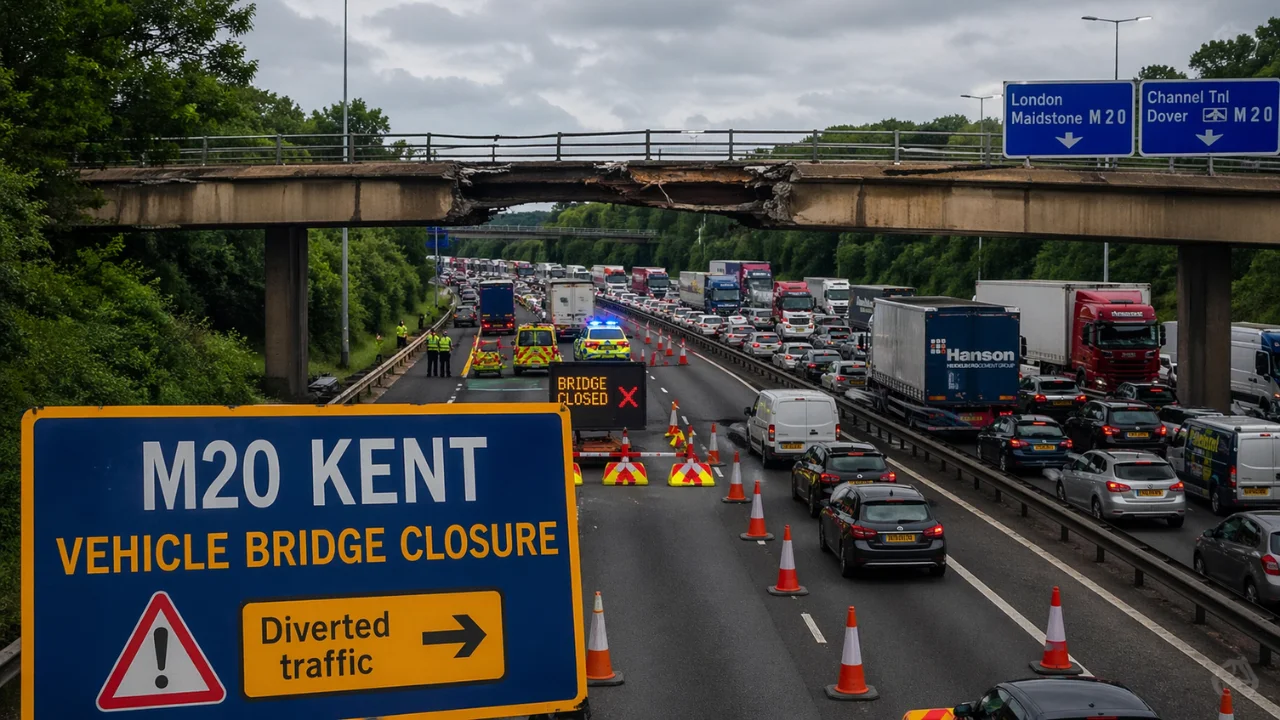
The turning point was the August 2025 crash near Wrotham. A tractor separated from its trailer while crossing the A227 bridge and dropped onto the M20 below. That single moment forced a full shutdown in both directions.
The motorway didn’t reopen quickly. Emergency crews had to deal with fuel leakage, wreckage, and structural concerns. The driver was seriously injured and airlifted. Parts of the road surface were damaged badly enough to require urgent repairs before traffic could move again.
That event pushed the phrase m20 kent vehicle bridge closure into public attention. Since then, every new delay or shutdown gets tied back to it, even when the cause is completely different.
Why this motorway can’t afford frequent closures
The M20 isn’t just another road. It carries freight heading to Dover and the Channel Tunnel. When a m20 kent vehicle bridge closure happens, it doesn’t stay local.
Traffic backs up quickly. Lorries don’t have space to reroute easily. Smaller roads nearby start absorbing overflow traffic and become congested within minutes. The longer the closure lasts, the worse the knock-on effect becomes.
This is why even short-term disruptions feel bigger than they should. The route is too important to fail, yet it keeps getting interrupted.
There is no permanent m20 kent vehicle bridge closure — but that doesn’t solve anything
A lot of people assume there’s an ongoing closure. That’s not true. There is no permanent m20 kent vehicle bridge closure in place.
But that doesn’t mean drivers are safe from disruption.
What exists instead is a cycle of temporary closures. One day it’s an accident. Another day it’s emergency repairs. Then you get freight control measures slowing everything down. Each situation looks different on paper, but the result is the same for drivers stuck in traffic.
Uncertainty is the real issue here, not a single blocked bridge.
The real causes behind repeated m20 kent vehicle bridge closure incidents
Accidents that escalate quickly
The 2025 tractor crash proved how severe bridge-related incidents can be. When heavy vehicles are involved, damage spreads beyond a single lane. Entire sections of motorway can be forced to close.
These aren’t rare enough to ignore. High traffic volume increases the chances of something going wrong.
Structural and maintenance problems
Bridges and road surfaces on busy routes wear out faster. When a joint fails or a section weakens, authorities don’t wait. They close it and fix it immediately.
This is another reason the m20 kent vehicle bridge closure issue keeps returning. Maintenance doesn’t always come with advance warning.
Freight pressure and traffic control systems
When cross-channel routes face delays, the M20 becomes a holding point. Systems like Operation Brock are used to manage congestion, often restricting lanes or slowing traffic deliberately.
From a driver’s perspective, it feels no different than a m20 kent vehicle bridge closure.
The sections of the M20 most likely to shut down
Not every part of the motorway faces the same risk.
The stretch between junctions 1 and 3 near Wrotham has seen some of the most serious incidents. That’s where the bridge accident happened, and it remains a sensitive area.
Further along, between junctions 7 and 9 near Maidstone and Ashford, closures tend to come from maintenance work or infrastructure wear.
If you’re driving regularly on these sections, the chances of encountering a m20 kent vehicle bridge closure situation are higher than elsewhere.
What actually happens when the motorway shuts
When a m20 kent vehicle bridge closure begins, the sequence is fast and disruptive.
Traffic is halted or redirected almost immediately. Emergency services secure the area. Engineers assess damage, especially if a bridge is involved. Cleanup teams deal with debris, spills, and damaged barriers.
Only after all of that can repairs begin. If resurfacing or structural checks are needed, delays stretch longer than expected.
What sounds like a short closure on paper often turns into hours of waiting for drivers.
Why drivers are always one step behind
Most people only find out about a closure after they’re already stuck. That’s part of the frustration behind repeated searches for m20 kent vehicle bridge closure updates.
Traffic apps react after the problem starts. Radio updates take time to spread. By the time warnings reach a wider audience, congestion has already built up.
There’s no real buffer. You either catch the update early or you sit in the delay.
Freight traffic makes every closure worse
Freight vehicles don’t just disappear when a road closes. They stack up.
When the M20 is disrupted, lorries heading to ports can’t move freely. Space runs out quickly. Traffic management systems step in, limiting lanes or holding vehicles in place.
Even if the closure is technically short, the recovery takes longer because of the backlog.
This is why every m20 kent vehicle bridge closure feels bigger than the incident that caused it.
The reliability problem no one is fixing
Closures themselves aren’t unusual on major roads. The real issue is how often they happen here.
Drivers need consistency. Businesses need predictable travel times. Repeated m20 kent vehicle bridge closure incidents break that reliability.
It’s not just about one bad day. It’s about not knowing when the next disruption will hit.
That uncertainty affects planning, costs, and daily routines.
What drivers should realistically expect going forward
There’s no sign this pattern will disappear soon.
Traffic levels remain high. Freight demand continues to grow. Infrastructure is under constant pressure. All of that points toward more disruptions, not fewer.
Drivers should assume that a m20 kent vehicle bridge closure can happen at any time and plan with that in mind. Checking live updates before travel isn’t optional anymore.
Relying on the motorway without a backup plan is risky.
Final take
The idea of a single m20 kent vehicle bridge closure is misleading. What exists is a repeated cycle of shutdowns caused by accidents, repairs, and traffic pressure. Each one disrupts travel in a slightly different way, but the outcome is always the same: delay, frustration, and lost time.
If you depend on the M20, the smart move is simple. Expect disruption before it happens, not after.
FAQs
1. Why does the m20 kent vehicle bridge closure keep happening instead of being fixed permanently?
Because each closure comes from a different cause. Accidents, structural repairs, and freight congestion all trigger separate shutdowns, so there isn’t one single fix.
2. Which time of day is most risky for encountering a closure?
Peak freight hours and early mornings tend to be more vulnerable, especially when overnight repairs extend into daytime traffic.
3. Are bridge-related incidents common on the M20?
They’re not daily events, but when they happen, they are serious enough to shut down large sections of the motorway.
4. How long does it take for traffic to recover after a closure ends?
Recovery often takes longer than the closure itself, especially when freight traffic builds up during the disruption.
5. Is there any reliable alternative route during a closure?
Diversions exist, but they quickly become congested. Local roads aren’t designed to handle motorway-level traffic for long periods.